Thursday, January 26, 2012

The Iron Lady

(Dir. Phyllida Lloyd, 1947)
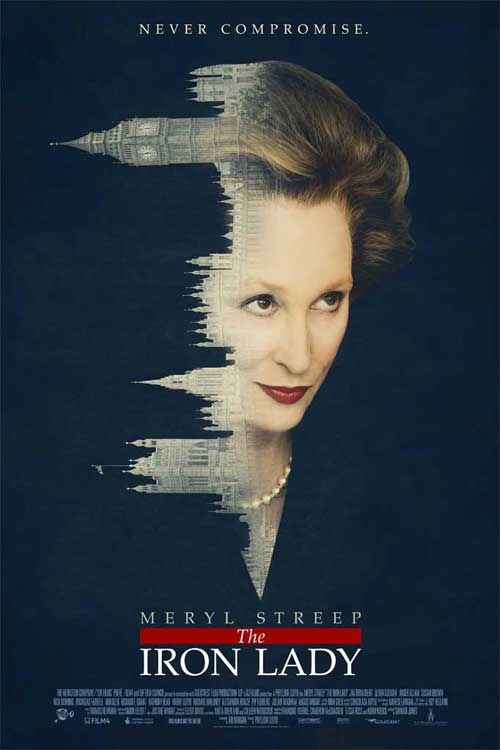
Directed by Phyllida Lloyd, The Iron Lady is a biographical film about the Britain’s longest serving Prime Minister of the 20th century, Margaret Thatcher, played by Meryl Streep. Her remarkable story is told by flashbacks to various moments in her life from an elderly Lady Thatcher who is struggling greatly with the early stages of dementia. She finds herself constantly reminiscing with her late husband Dennis (Jim Broadbent) and is almost unable to distinguish between the past the present.

I usually do enjoy the whole flashback approach toward films like this but in the case of The Iron Lady I don’t think it works very well. It takes a while for things to take off and there is too much time on spent on the elder Thatch and her current mental state. I admit that  it does a very good job of showing us the audience the heartbreaking reality of someone who is suffering from dementia and how it affects not only them but their loved ones. But overall I just found it to be really depressing; which I’m sure was the point but it just didn’t work for me. And the little scenes between Thatcher her late husband Dennis are quite clever but it gets really annoying, in particular Dennis who acts more like a child than anything. I felt like shouting at the screen “Shut up and leave your wife alone!” Now with all that aside it is a very fascinating look at a very controversial world leader.

The film covers the significant moments of Thatcher’s early life and later on her years as England’s Prime Minister; such as the trade union strikes that brought England to the very brink of despair and the Falklands War. They’re not covered in great detail but enough so to make them entertaining and genuinely interesting. In regards to her character, her ability as a leader as well as her flaws is clearly highlighted. She is a fearless, determined woman, confident that she has taken the right course of action on the countless challenges that she is faced with. But her autocratic style of leadership begins to cause frustration among MPs within her party due to her refusal to hear other alternatives and opinions. Having said all that I don’t consider myself to know a great deal about Margaret Thatcher, in particular her political career so I can’t really comment in regards to how accurate the film is.

Meryl Streep’s performance is so good that it’s frankly a little frightening. However one could easily view it more as a very accurate impersonation rather than a performance. I’ve been watching a number of clips of the real Margaret Thatcher and it’s difficult to tell them apart; more so in characteristics as opposed to physical appearance in which there is a notable difference in my opinion. Performances from the supporting cast are also very good, who including Richard E. Grant and Anthony Head.

The Iron Lady is a solid biopic that I enjoyed despite its flaws. I recommended seeing it just for Streep’s performance along. – 3.5 STARS

Sunday, January 15, 2012

Dark Passage


(Dir. Delmer Daves, 1947) 

A very cool little film-noir starring Humphrey Bogart as Vincent Parry, a prisoner escapee who has been framed for the murder of his wife. With the help of a kind-hearted cab driver and disgraced surgeon he undergoes plastic surgery to conceal his identity. Now with a new face he and his lone ally Irene Jansen (Lauren Bacall), he sets out to try and clear his name.

Since revisiting The Caine Mutiny (1954) earlier this years I’ve been sucked right in the movies of the late Hollywood giant Humphrey Bogart. With still many more to see Dark Passage is the most recent and the second I’ve seen out the four films in which he starring along side Lauren Bacall, the first being Key Largo.

I really enjoyed this film. The first person perspective at the beginning works great. It had me glued to screen and only hearing Bogey’s iconic voice it made me want to see his face so badly; which we don’t until a good third of the film is over. It’s shot very well; it’s stylish and captures the city of San Francisco in all its breathtaking beauty. Performances are great all round with a strong cast of characters, Bacall just absolutely shines along side Bogart.
A very good film if you’re a fan of the genre and style of film making, and a must see if you’re a fan of its two stars.  
- 4 STARS

The Gruen Transfer

“Named for Victor Gruen, who designed the very first shopping mall. The term describes that split second when the mall’s intentionally confusing layout makes our eyes glaze and our jaws slacken… the moment when we forget what we came for and become impulse buyers.” – Will Anderson

Around this time last year I was home in bed suffering from my first case of stomach flu, when my mum told me about a show on ABC called the Gruen Transfer. With nothing else decent on television I decided to watch it. 

The Gruen Transfer is a panel discussion show created by Andrew Denton and presented by comedian Will Anderson. Each week Anderson is joined by panelists Russel Howcroft and Todd Sampson, who are both industry insiders from the world of advertising. Together they discuss TV advertisements; and the science and techniques behind them. 

Left (Todd Sampson), Center (Will Anderson) and Right (Russel Howcroft)
The show is broken up into various segments which include “How Do You Sell”, “Ad of the Week” and my personal favourite “The Pitch”, where two advertising companies are given the task of creating an advertisement for an unsellable proposal, service or product which is determined by the show’s host; the results are often hilarious from both parties. 

In my opinion The Gruen Transfer is light entertainment at its finest. The show is intelligent within its interesting discussions but without being too serious or boring. It’s funny, as many of the commercials discussed provide plenty of humorous material for the panelists. 

Russel Howcroft and Todd Sampson are just absolute perfect choices for the show as they are almost polar opposites in their opinions, they disagree 90% of the time and it’s great to watch. 

Love him or hate him, Will Anderson is a fantastic host. He’s quick with his one liners, makes valid contributes to the many discussions and most importantly he knows when to be funny and when not to be funny, as the panel does at times talk about some pretty serious and confronting issues. 

At the time I started watching, the show was running a four episode special that focused primarily on the 2010 Australian Federal Election and advertising campaigns from past elections, here in Australia and overseas. This brief series was known as The Gruen Nation which was just as good as the regular series.

Saturday, January 14, 2012

Hugo

(Dir. Martin Scorsese, 2011)

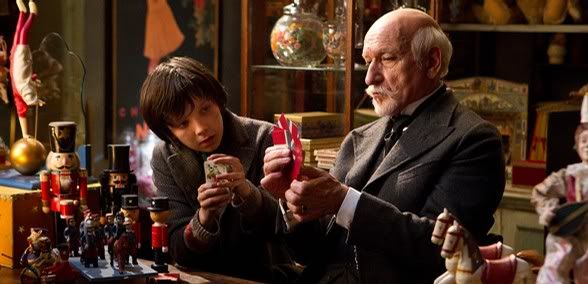
Hugo is a family adventure drama by director Martin Scorsese, based on Brian Selznick's novel The Invention of Hugo Cabret. Set in Paris during the early 1930s young Hugo Cabret played by Asa Butterfield who lives alone inside the walls of railway station where he spends his time maintaining the clocks, whilst stealing food and working to repair an automaton that his late father (Jude Law) had found discarded in a museum. Convinced that it contains a message from his father, Hugo goes to desperate lengths stealing mechanical parts to repair the mysterious machine, which eventually gets him into trouble from a sad toy shop owner played by Ben Kingsley.    

If you have a passionate love for cinema you have to go see Hugo and definitely in 3D. I absolutely loved this movie and had such a profound feeling of appreciation while watching it. Scorsese’s love of cinema not only shows but it shines through this film which is such a wonderful and heartfelt tribute to the early pioneers of filmmaking and of course the emotion of silent film ear, which was no doubt a strong influence.

The plot is very well executed that has you hooked with about 10 minutes. It’s well paced with an element of mystery that unfolds piece by piece eventually all coming together nicely for a very satisfying ending. There are subplots involving some of the supporting characters that blend in well and do not distract from the overall story. It appeals to such a wide audience especially children and has a mixed style of humour, some of which is aimed directly at adults which I really enjoyed.  

The use of the 3D effect in Hugo looks amazing and works effectively to enhance the overall enjoyment of the movie; which is actually saying a lot coming from me as I’ve never been a supporter of 3D. I still think its future is limited but Scorsese really has done something special in this case.    

Now I must talk about cinematography and set design. The cinematography in Hugo is stunning to say the least. They way it captures emotion of not only the characters but of the many locations through out the movie is breathtaking. As well as creating a sense of enormity inside the railway station; for instants the many shots of the inner workings inside the station clock tower. It puts the audience in Hugo’s shoes allowing us to see the world from his point of view.  Set design is what you would come to expect from a Scorsese film, unbelievably detailed and rich with character. Production designer Dante Ferretti who has working on a number of Scorsese’s films creates a labyrinthine interior to the railway station that adds to its scale.

As far as performances go you can’t get much better than this. Asa Butterfield is brilliant as Hugo who is such a likeable and inspiring character, but the best in my opinion goes to Ben Kingsley who is just astounding giving one of the most emotional and heart breaking performances I’ve seen in a long time. The rest of the supporting cast are all great especially Sacha Baron Cohen as the ever watchful station inspector.

Hugo is a movie about movies that was a real treat to see on the big screen and a very memorable experience in general. I’m glad I chose an early session to see it because there were only about five people in the audience which made it much more relaxing and free of distraction. - 5 STARS